It turns out that “only the basis” is not very meaningful.
When it comes to make the software better, you need a combination of insight and action: Insights to tell you where users struggle and what causes problems, and actions to guide the user to a better experience.
The position of userpilot as a solution for a new small team starts that requires guidance in fast applications and basic use metrics. But even in this limited context, the platform fails to provide the type of insight needed to overcome the most common use cases faced by product leaders. Here are ten questions related to this use case that you can answer easily in Pendo – but not userpilot.
Understand the user’s behavior and journey to increase adoption and income
1. Where did the user go after seeing my guide?
Able to understand where users navigate in your product after seeing a guide to validate how effective this guide is in driving the desired behavior. Unfortunately, mapping the user’s behavior of the userpilot user guide in the path report is not possible without investing in special dev work.
With Pendo, the team can see where the user goes after the view of the guide instantly. Besides mapping their entire journey before the guide. This out-of-the-box functionality is even included as a tattle for the readymade dashboard or a single widget.
Want to learn more about Pendo?
Try the FREE Pendo
2. How is the multi-step onboarding guide I changed behavior throughout funnel?
It is very important to be able to see how every step of your onboarding guide helps users get acquainted with your product or achieve their duties. However, to see the steps of guidelines in the userpilot funnel, the team must manually mark each individual step in all their guidelines, and label them with different names that they hope people recognize. Pendo did it. The team can make every step of the guide they use (for orientation or other goals) Steps of funnel, and can see whether the user sees or dismissing the guidelines in each.
3. What is the optimal user’s journey through workflow? How long? Is that what most users do?
For the product team, it can identify optimal trips through workflow is very important to optimize their user experience and time to respect. This is especially true when designing an onboarding process that brings users to the main activation event or the moment “AHA”.
Userpilot does not come with designated workflow or travel report, and there is no way to track the time needed by different users to complete certain workflows without manual analysis. With pendo Workflow journeyThis information is on your fingertips.
Knowing what to prioritize to minimize Churn, cut costs, and reduce risks
4. Where are the most frustrated users at this time and where should I focus on the improvement?
There is no perfect product, and at certain times there will be a list of washing and improvement that must be done. But how do you know where to start? In general, the answer is: where your user experiences the most pain.
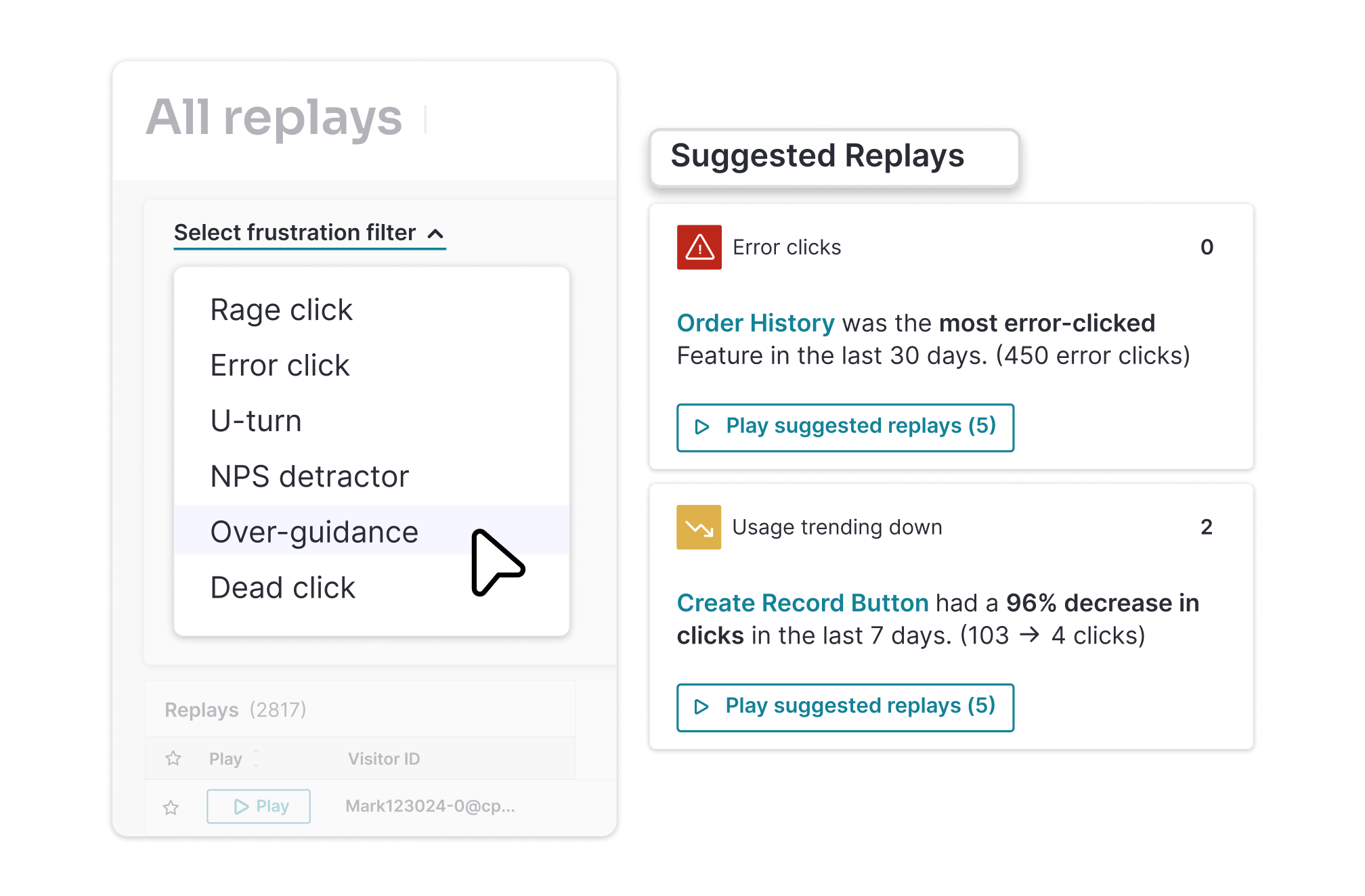
With userpilot, there is no way to assess behavior throughout your product with various types of user frustration and determine the biggest problem. If you want to see where the user has the most click error (often indicating an unknown bug), for example, userpilot cannot provide answers automatically. You have to filter out static user data manually or broken feedback to find friction points. With pendo, recommended re -shows and frustration trends appear directly for you. This allows the team to prioritize problems based on user pain supported by data, often that they may not know.
5. Is there a main friction point, such as a slow page load or unwilling bug that I don’t know?
The action you take to improve a product is only as effective as the insight that underlies them. Without these signals, there is no way to be proactive about overcoming user problems and minimizing Churn. You don’t know what you don’t know – and for users of users, it’s a real problem. Userpilot does not provide a way to see the analysis of general frustration or recommended re -shows. Pendo has all this, and more.
6. Does my road map have the right priority?
What should be prioritized by your team’s road map to increase income and reduce Rusk Churn? How do you know you make the right investment in the future of your product at the right time? If you use userpilot, you don’t know. Userpilot does not have an integrated priority framework, and users cannot accept recommendations driven by AI to inform road map decisions.
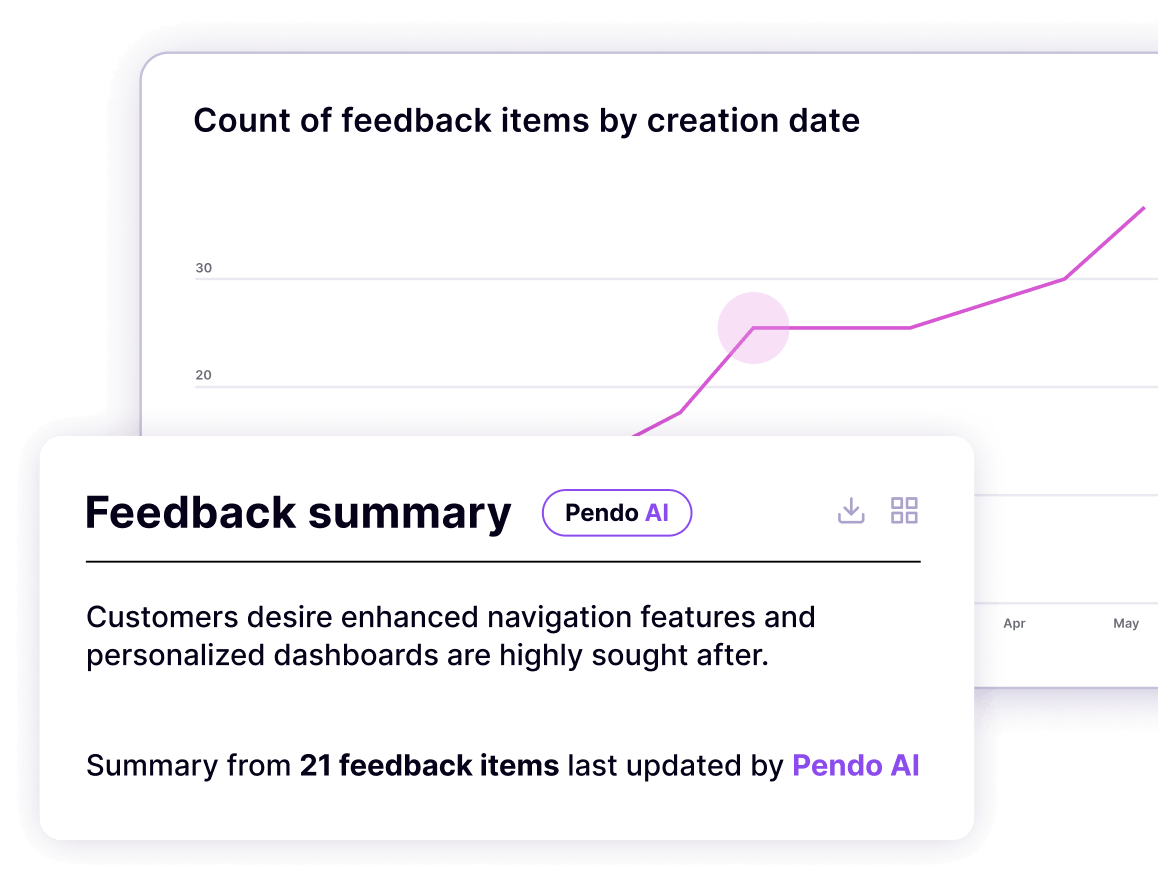
Pendo combines analytical use of use, frustration signals, and qualitative feedback powered (polls in applications, NPS responses, etc.) through listening products to give you a complete picture of user sentiment. You can filter based on the type of account and income if you want to get more granular about what to build.
Linking your product performance to business results: Cross-Sell, Product Leaded Growth, and more
7. Which features are “sturdy” in various user segments?
Which of your features see the number or percentage of the highest user who returns to the Daily or Monthly Horizon? Userpilot does not have an insight into retention or sticky in one view. It also does not allow you to see how sticky comparing in various user segments.
With Pendo, you can easily compare the use and involvement in several features or events in one view and measure the frequency of events, median use, or repeated involvement for any features with any user segment. You immediately know what drives the behavior of habits vs. use once.
8. Which feature moves the most needle to the conversion from the experiment to the fee?
If you want to increase conversation rates from free to paid or standard to premiums, you need to identify features or a series of features that make users experiment to the “AHA” moment. Userpilot does not offer a way to compare an increase in vs. customer segments that do not expand in a single display for comparison and tracking. And have limitations on how many events you can compare in one report. With Pendo, you can group and compare these segments and features in one report to quickly see the behavior and use that distinguishes which ultimately leads the growth strategy led by your product.

9. What is the percentage of experimental users who held a core event in their first week?
The core event is the main action that indicates a significant involvement with your product. It could be anything, from seeing a vital pages to completing a significant workflow. Completing the core event or a series of core events is another conversion indicator, so it is important to keep your fingers on the pulse of your experimental user behavior in the front.
For teams who want to know what percentage of test users they complete the core event in the first seven days or other time periods, the userpilot appears short. While technical information is there, it requires extraction and manual calculation (adding your own formula) to arrive. Pendo, on the contrary, gives a team -ready formula and screening of the dynamic segment/date that answers this question, so you can see how effective, for example, a motion of your trial trials.
10. How to use this quarter compared to the last quarter for my main account?
It is important for the team to find out whether and how the target target account utilizes their products. A sudden decline in the use of the month to month, for example, can show unwarming frustration and the risk of Churn which should trigger a team of customer success to proactively check-in. Userpilot does not offer multi-date comparisons for user behavior reports. The pendo immediately showed the trend of segments chosen for several dates in one report.
When it comes to what uses userpilot vs what Pendo is doing, the contrast is clear. Why throw away money for products that won’t give you the insights you need? Try the free pendo today.
Game Online
Motivation
News
Pendidikan
Pendidikan
Download Anime
Gaming Hub
Game online adalah jenis permainan video yang dimainkan melalui jaringan internet. Game ini memungkinkan pemain untuk berinteraksi dengan pemain lain secara real-time, baik itu dalam bentuk kerja sama, kompetisi, atau eksplorasi dunia virtual bersama-sama.