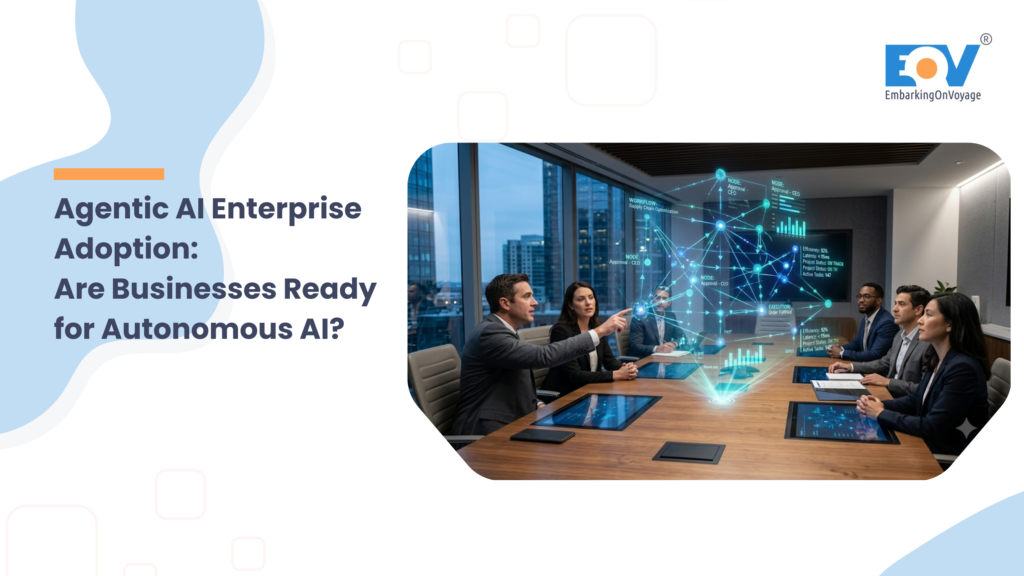
The adoption of AI agents in enterprises is no longer just a futuristic concept; this is the next important phase in digital transformation. For the past three years, conversations among companies have revolved around Generative AI. Organizations are investing heavily in copilots, chatbots, and summarization tools to accelerate knowledge work. However, an important question remains: Have these investments fundamentally changed the way the company operates? For many people, the answer is still no.
The next phase of enterprise transformation is no longer about AI generating output; it’s about AI doing the work. Welcome to the era of Agentic AI autonomous software systems capable of observing, reasoning, making decisions and executing actions within defined governance.
Even though technology is developing rapidly, company readiness is still uneven in large countries such as Germany, the Netherlands, the UK and the United States. The question is no longer whether autonomous AI will become operational, but whether leaders are ready to adopt it responsibly.
From Intelligence to Execution: The Agentic Shift
Traditional AI focuses on prediction; Generative AI extends to content creation. Agent AI moves beyond both by focusing entirely on outcomes, not guidance.
Generative AI  ➡️  Creates Information
Agentic AI     ➡️  Creates Outcomes
Rather than simply flagging disruptions in the supply chain, autonomous agents can evaluate alternative suppliers, coordinate with procurement, initiate approvals, and provide up-to-date information to stakeholders—all while maintaining human oversight. For CXOs, this change is important because business value is measured based on revenue growth, operational efficiency, and risk reduction, not based on the number of orders executed.
Bridging the Corporate Readiness Gap
Despite growing enthusiasm, there are many barriers preventing the adoption of Agentic AI in enterprises:
- Fragmented Data: Autonomous systems rely on connected and managed data. Disconnected platforms make autonomous decisions unreliable.
- Process Maturity: Many workflows depend on undocumented exceptions. Processes must be standardized and digitized before AI can carry them out.
- Governance Framework: Agentic AI operates within specified boundaries. Organizations need a framework that defines authority, escalation paths, and audit trails. For businesses looking to improve their infrastructure, implementing a dedicated digital product engineering framework provides a strong foundation for cross-functional automation.
- Organizational Change: Successful implementation requires leadership alignment and a willingness to redesign operating models, not just digitize legacy processes.
Agentic AI in Action: Travel, Healthcare, and Retail
The power of autonomous execution has reshaped critical sectors:
1. Autonomous Travel Operations
Modern booking engines are transactional. The autonomous travel platform instantly detects canceled flights, evaluates alternatives, books hotel accommodations, and reallocates itinerary components according to traveler preferences—resolving disruptions before customers even contact support.
2. Smart Healthcare Coordination
Healthcare administrative workflows consume a significant amount of organizational effort. Agentic AI can easily manage clinical documentation, insurance verification, operating room scheduling, and discharge planning while strictly adhering to clinical governance.
3. Autonomous Trading in the Retail Sector
Rather than simply recommending products, autonomous agents continually evaluate inventory, pricing strategies, and customer behavior to dynamically personalize offers and coordinate fulfillment, thereby maximizing long-term customer value.
Why Governance is Your Key Competitive Advantage
As companies implement autonomous systems, the debate must shift from: whether AI can make decisions How the decisions are regulated.
“Trust is built not by eliminating the role of humans in decision making, but by ensuring that autonomous systems operate transparently, consistently, and in accordance with clear company policies.”
Establishing clear decision boundaries, explainable standards, and ongoing monitoring transforms governance from a regulatory burden to a fierce competitive advantage. It is critical for companies to align their architecture with modern frameworks such as the EU AI Act’s official compliance guidelines, which require strict risk management for autonomous software.
Redesigning the Enterprise of the Future
The organizations that lead the next decade will not necessarily be those with the largest budgets, but those that successfully integrate autonomous execution into daily workflows..
Boards should pay attention to technical metrics such as chatbot usage and focus strictly on real business outcomes: reduced operational costs, faster problem resolution, and shorter procurement cycles. Our dedicated team at EOV Digital specializes in turning these operational bottlenecks into seamless, automated value drivers. The future belongs to the leaders who enable AI to execute responsibly, rigorously measure results, and build adaptable and self-sustaining companies.
About the Author
Abhishek Nag is the CEO & Founder of EOV Digital, an AI native digital product engineering company. EOV partners with enterprise leaders in India, the US, and Europe to build production-grade Agent AI systems that autonomously execute business workflows and deliver measurable business value.
PakarPBN
A Private Blog Network (PBN) is a collection of websites that are controlled by a single individual or organization and used primarily to build backlinks to a “money site” in order to influence its ranking in search engines such as Google. The core idea behind a PBN is based on the importance of backlinks in Google’s ranking algorithm. Since Google views backlinks as signals of authority and trust, some website owners attempt to artificially create these signals through a controlled network of sites.
In a typical PBN setup, the owner acquires expired or aged domains that already have existing authority, backlinks, and history. These domains are rebuilt with new content and hosted separately, often using different IP addresses, hosting providers, themes, and ownership details to make them appear unrelated. Within the content published on these sites, links are strategically placed that point to the main website the owner wants to rank higher. By doing this, the owner attempts to pass link equity (also known as “link juice”) from the PBN sites to the target website.
The purpose of a PBN is to give the impression that the target website is naturally earning links from multiple independent sources. If done effectively, this can temporarily improve keyword rankings, increase organic visibility, and drive more traffic from search results.