If you enter any engineering field today, you will see developers using AI. They trawl through Copilot’s suggestions, ask conversational agents to debug cryptic errors, and create boilerplate code.
But there is a big gap between “our engineers use AI tools” and “our engineering organization uses AI technologies.”
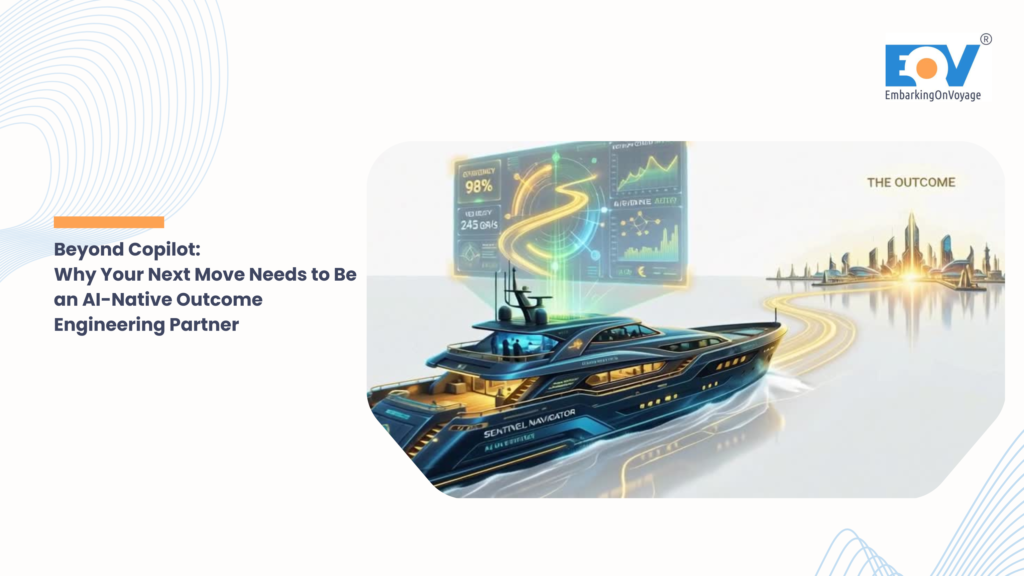
Many companies looking for a technology partner end up purchasing traditional staff augmentation with a chatbot license attached. Choosing an Engineering Partner Genuine Results AI represents a fundamental architectural shift in the way software is built. It focuses on updating your organization to achieve specific business outcomes, rather than simply delivering code.
Here’s what the change means, and why it’s the defining engineering model of 2026.
AI-Assisted vs. AI-Native: Important Differences
To understand the value of an outcomes engineering partner, we first need to differentiate between adding AI to your workflow and building your workflow around A.I.
- AI Assisted Engineering: Traditional team workflow where individual developers use AI to code faster. The software development life cycle (SDLC) remains the same. Sprint planning, code review, and deployment remain unchanged. Productivity gains accrue to the individual and are often lost due to team bottlenecks.
- AI-Native Engineering: The entire SDLC is designed from scratch based on large language models (LLM) and agent workflows. The AI agent acts as a key collaborator handling the first phase of work across planning, test scaffolding, and code generation. The human role is shifting from writing raw code to organizing, reviewing, and defining architectural intent.
AI-powered vendors give you faster typists. AI Genuine Outcome Engineering Partners fundamentally changes the economics of your delivery.
What Do Outcome Engineering Partners Actually Do?
Results-focused partners don’t just ship you products and then disappear. They are vehicles of transformation. Their involvement happens at the organizational level: they staff, train, and manage engineering teams that permanently change the way your business builds software.
Here’s what differentiates this approach from traditional delivery teams:
1. Centaur Execution Model

These partners operate on a “Centaur Model,” where work is explicitly divided between AI Agents and human engineers.
- AI leads first pass: Autonomous agents assemble user stories from meeting transcripts, create test scaffolding, and propose refactorings.
- Man presides over judgment: Senior engineers interrogate AI assumptions, address complex edge cases, and make high-stakes architectural decisions.
2. Structured Day One AI Governance
In native AI settings, the volume of code generated is often 3x to 5x higher than traditional methods. True partners establish strict and automated governance. All AI-generated code must pass continuous security gates, OWASP security standards, and automated testing before humans review it.
3. Accountability for Business Results
Traditional IT outsourcing bills for hours worked or seats. Outcome engineering partners attribute their success to measurable delivery metrics:
- Cycle time: How quickly does an idea reach production?
- Output: What is the feature output per engineer?
- Defect exit rate: Are bugs caught by AI reviewers before integration?
Is This the Right Model for Your Company?
Not every project needs a transformation partner. If you have a short-term project with a fixed scope, a dedicated delivery team is fine. If you only need a dedicated developer for three months, traditional staffing is possible.
However, you need an AI Native Results Engineering Partner if:
- You have a new digital product to build under strong time-to-market pressure.
- You want to shorten new product development cycles by 30-50% while relying on secure data channels.
- You want to transition your senior engineers into “mini-CEOs” in their product domains, not manual coders.
The main thing is
Purchasing AI tools is easy. Restructuring an engineering organization to leverage these tools safely, securely, and quickly is extremely difficult. At Embarking on Voyage (EOV), our AI-native digital product engineering bridges the gap. We ensure that your investment in Agentic AI translates into real business results, unmatched speed, and a permanently improved engineering culture.
PakarPBN
A Private Blog Network (PBN) is a collection of websites that are controlled by a single individual or organization and used primarily to build backlinks to a “money site” in order to influence its ranking in search engines such as Google. The core idea behind a PBN is based on the importance of backlinks in Google’s ranking algorithm. Since Google views backlinks as signals of authority and trust, some website owners attempt to artificially create these signals through a controlled network of sites.
In a typical PBN setup, the owner acquires expired or aged domains that already have existing authority, backlinks, and history. These domains are rebuilt with new content and hosted separately, often using different IP addresses, hosting providers, themes, and ownership details to make them appear unrelated. Within the content published on these sites, links are strategically placed that point to the main website the owner wants to rank higher. By doing this, the owner attempts to pass link equity (also known as “link juice”) from the PBN sites to the target website.
The purpose of a PBN is to give the impression that the target website is naturally earning links from multiple independent sources. If done effectively, this can temporarily improve keyword rankings, increase organic visibility, and drive more traffic from search results.