The company’s robust adoption of the RAG Architecture has transformed the way organizations deploy Large Language Models (LLM) over the past two years. From intelligent copilots to automated customer support and enterprise tracking, AI is quickly moving from experiments to production environments.
But as businesses start to take AI seriously, they discover something important: LLMs are impressive, but not always reliable.
Basic models can produce fluent answers, summarize documents, and even write code. However, when you ask specific questions about your business, customers, operations, or internal systems, the limitations become clear. The AI starts guessing.
And in a corporate environment, guessing is dangerous. That’s why RAG has become one of the most important architectural patterns in modern AI native product engineering.
The Core Problem with Traditional LLMs (And Why Enterprise RAG Architecture Wins)
LLMs are trained on large amounts of internet-scale data. They learn patterns, relationships, and language structures from billions of documents. However, they also have major limitations:
- Static Knowledge: They only know the information available up to the breaking point of their training.
- Data Isolation: They cannot access company data directly by default.
- Ownership Blind Spots: They struggle with private, internal business information.
- Hallucinations: They may confidently give wrong or made-up answers.
- Lack of Context: They basically don’t understand your specific organizational structure or policies.
For example, an employee of a company might ask: “What is our latest customer refund policy for European clients?”
A stand-alone LLM might produce professional-sounding answers. However this may not reflect current policy changes, regional compliance rules, or internal documentation updates. This creates huge operational risks.
This is where RAG changes the equation.
What is Retrieval-Augmented Generation (RAG)?
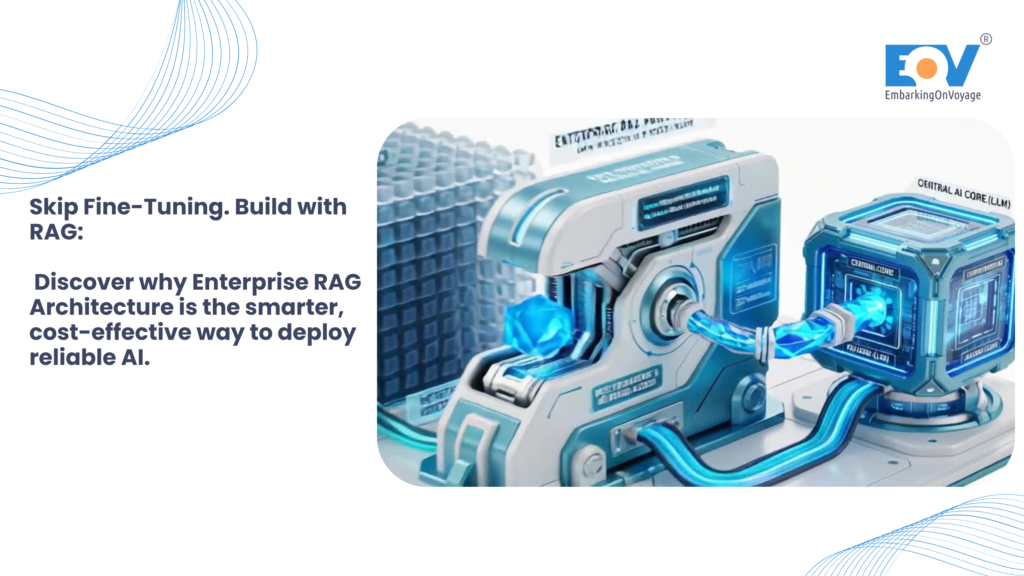
A Enterprise RAG Architecture is a system design that connects AI models with external knowledge bases that connect AI models with external knowledge bases to optimize performance. It combines:
- Information retrieval system
- Vector database
- Semantic search
- Large Language Models
Rather than relying solely on what LLMs learn during training, RAG takes relevant business information in real-time and provides it as context before generating a response.
In simple terms: Take first → Earn second.
This small architectural shift significantly improves response quality, contextual accuracy, enterprise trust, and business usability.
Why Companies Are Quickly Adopting RAG
Many organizations initially believe that they need to fine-tune the LLM for each business use case. However, refining the foundation model is resource-intensive and computationally expensive. Enhancements lead to higher infrastructure costs, retraining complexity, governance challenges, and slower updates.
Modern Enterprise RAG architectures offer a much more practical and scalable alternative.
Rather than retraining models every time your data changes, organizations simply update the retrieval layer or knowledge source. By separating the knowledge base from the model weights, the system can access the latest domain-specific data instantly.
Enhancement vs. Enhancement RAG architecture
| Feature | LLM Refinement | RAG architecture |
| Data Update | Requires full model retraining | Instant (Updating vector database) |
| Cost | Very high computing costs | Very cost effective |
| Source Transparency | Black box (Unable to name source) | High (Can link to captured documents) |
| Risk of Hallucinations | Still prevalent in new data | Reduced significantly through grounding |
This makes AI systems faster to maintain, easier to scale, and much more flexible.
How RAG Actually Works
At EOV AI Native Engineering Lab, we build a robust architecture to ensure data flows securely. Production-ready Enterprise RAG Architectures typically follow a clear six-step workflow:
- Data Ingestion: Corporate documents (PDFs, logs, databases) are converted into vector embeddings.
- Storage: These embeddings are stored in a vector database.
- Ask: A user submits a prompt or query.
- Takeaway: Semantic search retrieves the most relevant information based on mathematical distance.
- Context Injection: Captured content is passed directly to LLM as explicit context.
- Generation: LLM produces highly contextual and accurate responses.
The result: AI answers using yours business data rather than general internet knowledge.
Real Business Example: Healthcare Support
Imagine a healthcare SaaS platform. A hospital administrator asked: “What is the approved workflow for patient insurance escalation in Germany?”
- Without RAG: AI may provide general and potentially non-compliant healthcare guidance.
- With RAG: The system securely retrieves internal SOP documents, regional compliance workflows, insurance escalation rules, and company policy documentation before produce the answer.
Now the responses provided are accurate, compliant, contextual and operationally useful. This is the difference between consumer AI and enterprise AI.
Why RAG Reduces Hallucinations
One of the biggest challenges with LLM is hallucinations. The model often produces responses that sound right even though they are actually wrong, detecting patterns that don’t actually exist.
RAG significantly reduces this risk by anchoring the LLM to specific, factual, and up-to-date data. Instead of guessing, AI refers to actual structured company documents, notes, knowledge bases, and content.
This is especially important in banking, healthcare, insurance, legal systems, and enterprise SaaS products. In a regulated environment, accuracy is more important than creativity.
Role of Vector Databases in RAG
Traditional database searches use exact keyword matching. Vector database search using meaning. This is one of the biggest breakthroughs that made modern RAG systems possible.
For example, a customer might search for: “Why did my travel reimbursement fail?” The actual document may contain: “Expense claim rejected due to policy validation.”
Traditional keyword searches may struggle here. Vector search understands semantic similarity and still retrieves relevant context.
Popular vector database technologies that form the backbone of this architecture include:
Simple Technical Example
Although production systems—like the one we validated through the EOV Pulse framework—involve complex vector reranking, access control, and clustering strategies, the core concepts are very clear.
A simplified .NET-based The RAG workflow looks like this:
C#

public async Task<string> GenerateAnswer(string query)
{
    // 1. Retrieve relevant data from the vector database
    var documents = await _vectorDb.SearchAsync(query);

    var context = string.Join("\n", documents);

    // 2. Inject the retrieved enterprise data into the prompt
    var prompt = $@"
    Using this enterprise context:
    {context}

    Answer this question:
    {query}
    ";

    // 3. Generate grounded response
    return await _llm.GenerateAsync(prompt);
}
In heavy production environments, these workflows include frameworks such as LangChain, Semantic Kernel, AI observability, and tight security controls.
Final Thoughts
Enterprise RAG Architecture implementation is quietly becoming one of the foundational layers of modern AI systems, one of the foundational layers of enterprise AI. Not because it makes AI more fashionable, but because it makes AI more fashionable useful.
RAG helps Large Language Models be contextual, reduce hallucinations, access enterprise knowledge, and deliver meaningful business results. For organizations building AI-based products or autonomous workflow systems, RAG has quickly moved from “nice to have” to “business critical.”
The future of enterprise AI will not belong to the companies that deploy the largest models alone. It will belong to companies that combine robust engineering, intelligent retrieval, contextual business data, and scalable architecture to create operational systems that can be trusted.
Is Your RAG Architecture Production Ready? Moving from a prototype to an enterprise-level AI system requires rigorous validation. Discover how we stress test and scale AI infrastructure in EOV, or perform an EOV Pulse check on your current picking system.
PakarPBN
A Private Blog Network (PBN) is a collection of websites that are controlled by a single individual or organization and used primarily to build backlinks to a “money site” in order to influence its ranking in search engines such as Google. The core idea behind a PBN is based on the importance of backlinks in Google’s ranking algorithm. Since Google views backlinks as signals of authority and trust, some website owners attempt to artificially create these signals through a controlled network of sites.
In a typical PBN setup, the owner acquires expired or aged domains that already have existing authority, backlinks, and history. These domains are rebuilt with new content and hosted separately, often using different IP addresses, hosting providers, themes, and ownership details to make them appear unrelated. Within the content published on these sites, links are strategically placed that point to the main website the owner wants to rank higher. By doing this, the owner attempts to pass link equity (also known as “link juice”) from the PBN sites to the target website.
The purpose of a PBN is to give the impression that the target website is naturally earning links from multiple independent sources. If done effectively, this can temporarily improve keyword rankings, increase organic visibility, and drive more traffic from search results.