Quick Answer
Hedera currently has the strongest fundamentals due to its corporate partnerships, unique decentralized governance model, massive network transaction activity, and ecosystem maturity. BlockDAG operates as an emerging early-stage network with a low market capitalization, while IOTA remains a niche network focused on decentralized digital identity, Internet of Things (IoT), and zero-fee operations. Investors seeking network stability and real-world utility often prefer Hedera, while investors targeting the expansion of decentralized utility may be more interested in BlockDAG.
Important Points
- ivy leading the group in institutional adoption, active mainnet usage, and structural maturity.
- BlockDAG seeks to combine the security structure of traditional blockchains with DAG-based scalability.
- IOTA continues to target machine-to-machine payments and localized digital infrastructure.
- Basic Winner: Hedera has the strongest on-chain metrics and revenue model today.
- Ecosystem Expansion: BlockDAG is relying heavily on consumer applications such as gaming to build initial traction.
Traditional block-by-block networks like Bitcoin and Ethereum require transactions to be packaged linearly into single, sequential chunks of data. When network traffic spikes, costs rise and processing windows slow down.
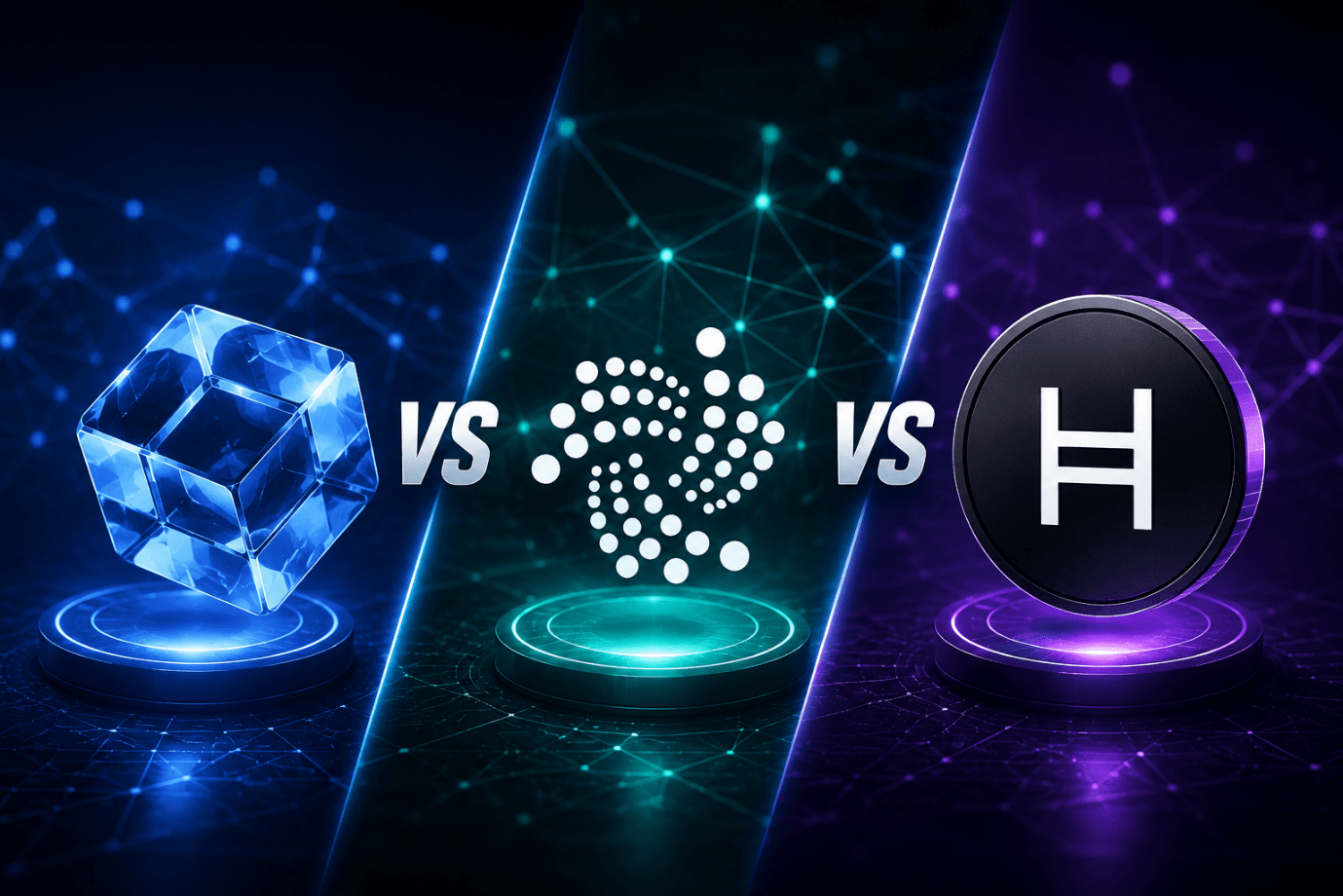
Directed Acyclic Graph (DAG) technology solves these structural limitations. Instead of a single chain, transactions are linked asynchronously like a web, processed simultaneously. This means speed and throughput can be increased as more users join the network. In this particular space, BlockDAG, IOTA, and Hedera are some of the most talked about competitors, each with a different corner of the market.
BlockDAG vs IOTA vs Hedera: At a Glance
| Feature | BlockDAG ($BDAG) | IOTA ($IOTA) | Hedera ($HBAR) |
| Architecture | DAG-Hybrid Blockchain | Tangled (DAY) | Hashgraph (DAG variant) |
| Consensus Model | Proof of Work Hybrid | Tangle-based validation | Asynchronous Byzantine Fault Tolerance (aBFT) |
| Transaction Speed | Up to 5,000 TPS | ~1,000+ TPS | 10,000+ TPS (Peak) |
| Average Cost | Variables by Application | Not felt ($0.00) | In USD and paid in HBAR; ConsensusSubmitMessage HCS increases to $0.0008 in 2026. |
| Market Capitalization | ~$3.70 million | ~$140 million – $160 million | ~$3.4 billion – $3.6 billion |
| Ecosystem Maturity | Early Retail | Moderate (EU Regulatory Pilot) | Advanced Company |
| Corporate Adoption | Low / Focus on the game | Moderate (Public Sector Pilot) | High (Google, Dell, FedEx, IBM) |
Understanding Three Projects
What is BlockDAG?
BlockDAG is a new project designed to combine the security framework of traditional proof-of-work mining with the fast processing execution of a web DAG structure. By organizing data asynchronously, data processing bottlenecks can be avoided.
- Ecosystem & Roadmap: The network shifted into utility mode, highlighting its live digital ecosystem, which includes an ongoing token buyback program.
- Market Performance: Primarily driven by aggressive online marketing, BDAG is actively traded on centralized platforms such as MEXC, where its micro-cap status and market volatility have many analysts closely evaluating its long term. Blockdag price prediction.
What is IOTA?
IOTA started with a strong thesis of IoT and machine-to-machine payments, but its current ecosystem also emphasizes digital identity, tokenization, notarization, supply chain, and public infrastructure.
- Tasteless Model: Transactions remain fee-free, making it uniquely optimized for machine-to-machine micropayments.
- Core Strengths: The company has a strong footprint in digital infrastructure initiatives in Europe and the Middle East, particularly around decentralized identity standards. However, the migration from the initial centralized “Coordinator” architecture has historical friction that the project continues to clean up.
What is Hedera?
Hedera uses “Hashgraph,” an alternative mathematical approach to DAG technology in which nodes constantly talk to each other, sharing transaction data through a process called “gossip-about-gossip.”
- Management Board: Hedera is governed by a rotating board consisting of global companies, institutions, and organizations, which gives the company strong credibility but also creates centralization concerns for some crypto users.
- Adoption: This is an enterprise-first network. Hedera has completed more than 71 billion cumulative transactions on its mainnet, maintaining a fast settlement time of 2.9 seconds.
BlockDAG vs IOTA vs Hedera: Fundamental Analysis
Technology and Scalability
Hedera dominates in sheer technical execution. The network is capable of exceeding 10,000 transactions per second (TPS) and consumes only 0.000003 kWh per transaction. BlockDAG claims a structural limit of 5,000 TPS after the update, despite lacking the historical public load testing of its peers. IOTA offers highly efficient data packaging for small devices but experiences throughput variations under sudden decentralized consensus load.
Adoption and Ecosystem Growth
Hedera’s Decentralized Finance (DeFi) Total Value Locked (TVL) reached over $208 million, driven by leading native applications such as SaucerSwap.
Ecosystem Maturity & On-Chain Traction
- BlockDAG ──> Newborn (Gaming/Casino/Retail Oriented use cases)
- IOTA ──> Custom (IoT data pipeline / public sector identity pilot)
- Hedera ──> Enterprise (71 billion+ transactions / Backed by Google, Dell, IBM)
IOTA relies on institutional research grants and industrial automation pilots. BlockDAG is still heavily focused on retail gaming and onboarding systems, missing the institutional adoption metrics found in the other two systems.
Tokenomics and Long-Term Value
- Hedera ($HBAR): Featuring a very limited supply of 50 billion tokens, with over 85% already in active circulation. Demand is driven by network transaction fees, which are pegged to the US dollar (e.g. $0.0008) but paid in HBAR.
- IOTA ($IOTA): It offers a completely heartless layout, meaning value generation relies on node staking and resource (“mana”) allocation rather than direct transactional fee generation.
- BlockDAG ($BDAG): Relies heavily on managed ecosystem initiatives, including a structured $0.05 network buyback program to maintain price stability for early round participants.
Security and Decentralization
Hedera uses the mathematical security of aBFT, which means it guarantees absolute consensus finality even if one third of the network turns malicious. Governance is highly centralized among large, trusted companies, although the distribution of validators is slowly opening up. IOTA is transitioning from centralized congestion to a completely permissionless state. BlockDAG promises classic proof-of-work style security, but the actual distribution of nodes remains unproven at scale.
Which DAG Projects are Best for Different Types of Investors?
Long Term Investors
For hands-off long-term capital allocation, ivy is an obvious structural choice due to the utility of its enterprise network, blue-chip backing, and reliable revenue model.
Highest Growth Potential
BlockDAG holds the most flexible advantages for portfolio expansion. Since the market footprint is small, any sustained adoption of in-house gaming applications can fuel a larger percentage movement.
Strongest Real World Adoption
ivy wins cleanly, processing millions of active corporate transactions daily across supply chains, carbon credits and digital banking assets.
Risks to Consider Before Investing
- BlockDAG Risks: Extreme price volatility, aggressive promotion cycles, and untested node infrastructure pose major capital challenges.
- IOTA Risks: Sluggish long-term market momentum and complex technical challenges in developing a zero-cost security model.
- Heather Risks: Corporate-first governance creates concerns of centralization among crypto believers who distrust corporate control.
Expert Verdict: Which DAG Project Wins?
Although BlockDAG captured early retail interest and IOTA remains part of the niche IoT research, Hedera is a clear winner when it comes to fundamentals. It treats network infrastructure like a real business, featuring a pricing model pegged in USD, support from the world’s largest technology companies, and tens of billions of securely processed transactions.
Frequently Asked Questions
Is BlockDAG better than Hedera?
No, from a fundamental point of view. Hedera has far superior enterprise adoption, better proof of security, and higher on-chain capital liquidity. BlockDAG is only an alternative if you are specifically looking for low-cap assets with higher short-term price fluctuations.
Which DAG cryptocurrency has the strongest fundamentals?
Hedera ($HBAR). Its 71 billion+ transaction record, $208 million+ DeFi layer, and blue-chip corporate governance board put it well ahead of its DAG peers.
Why is Hedera considered an enterprise-level crypto project?
Because this system is governed directly by a board of 30+ large global companies (such as Boeing, FedEx, and IBM) and has fixed, predictable transaction costs and is isolated from market volatility.
What makes IOTA different from other DAG networks?
IOTA uses a fee-free model called Tangle, which is designed to allow microdevices to send data and micropayments to each other without friction.
Which DAG crypto has the highest upside potential?
BlockDAG ($BDAG), simply because of its small market valuation. Smaller crypto assets require less incoming capital to earn double-digit returns compared to multi-billion dollar networks like Hedera.
PakarPBN
A Private Blog Network (PBN) is a collection of websites that are controlled by a single individual or organization and used primarily to build backlinks to a “money site” in order to influence its ranking in search engines such as Google. The core idea behind a PBN is based on the importance of backlinks in Google’s ranking algorithm. Since Google views backlinks as signals of authority and trust, some website owners attempt to artificially create these signals through a controlled network of sites.
In a typical PBN setup, the owner acquires expired or aged domains that already have existing authority, backlinks, and history. These domains are rebuilt with new content and hosted separately, often using different IP addresses, hosting providers, themes, and ownership details to make them appear unrelated. Within the content published on these sites, links are strategically placed that point to the main website the owner wants to rank higher. By doing this, the owner attempts to pass link equity (also known as “link juice”) from the PBN sites to the target website.
The purpose of a PBN is to give the impression that the target website is naturally earning links from multiple independent sources. If done effectively, this can temporarily improve keyword rankings, increase organic visibility, and drive more traffic from search results.